Top Study Tips for Students to Boost Productivity and Exam Results
A complete authority guide to smart study techniques, focus strategies, memory hacks, and exam preparation systems used by top-performing students worldwide.
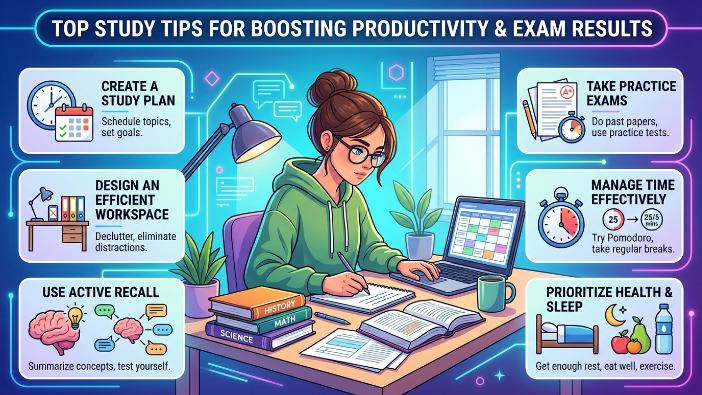
⚡ Executive Summary
The most effective way to study is not about adding more hours — it is about applying proven systems. This guide covers active recall, spaced repetition, the Pomodoro technique, the Cornell note-taking method, distraction control, and exam-week strategies that consistently improve grades. Built for school, college, university, and professional certification students preparing for GCSE, A-Levels, IELTS, NCLEX, USMLE, CFA, GMAT, SAT, and more — these are the top study tips that turn average performers into top scorers.
Introduction
Studying harder is not the same as studying smarter. Many students spend long hours rereading textbooks and still underperform on exam day. The reason is simple: time alone does not produce results — method does. The best students follow systems built on cognitive science.
This guide explains the most effective ways to study, prepare for exams, and improve concentration. Whether you are a high school student, a university freshman, a medical student preparing for the NCLEX or USMLE, or a professional studying for the CFA, GMAT, or IELTS — these top study tips will help you retain more in less time.
You’ll learn how to build a study plan, eliminate distractions, take better notes, practice active recall, schedule spaced repetition, and reduce exam stress. Every section delivers practical, classroom-tested advice. For deeper resources, visit our study tips library and AIPROSTUDY blog.
💡 Promise of This Guide
By the end of this article, you will have a complete blueprint to study smarter, not longer — and a memorization framework backed by neuroscience.
Why Effective Study Habits Matter
🎯 Featured Snippet
Why are good study habits important?
Strong study habits improve memory retention, lower exam stress, raise academic performance, and free up personal time. They turn studying from an exhausting task into a repeatable, measurable system.
🧠 Better Retention of Information
Smart techniques such as active recall and spaced repetition train your brain to store information in long-term memory rather than short-term cramming buffers.
😌 Reduced Exam Stress
Consistent preparation eliminates last-minute panic. Students who follow structured plans report significantly lower test anxiety.
📈 Improved Academic Performance
Research from learning psychology consistently shows that structured study methods outperform unstructured marathon sessions by wide margins.
⏰ More Free Time and Balance
Efficient studying creates room for hobbies, sleep, and social life — all of which improve cognitive performance.
- Higher exam scores with less time invested
- Stronger focus and faster learning curves
- Better mental health and balanced lifestyle
- Sustainable performance through entire semesters
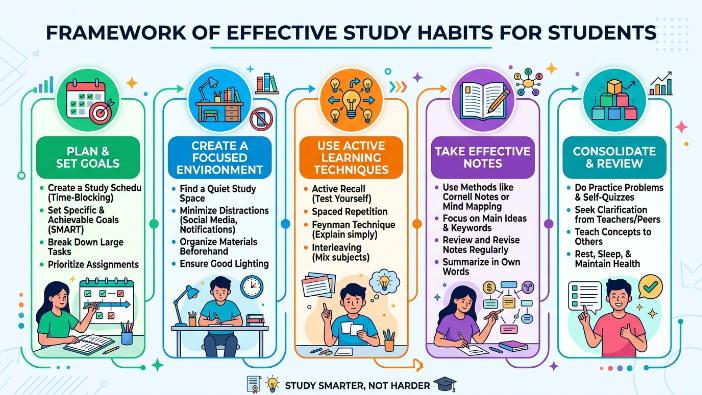
Create a Study Plan That Actually Works
A study plan converts vague intentions into measurable action. Without one, students drift from chapter to chapter without real progress.
🎯 Set Realistic Daily Goals
Define small wins per day — for example, “complete 20 organic chemistry questions” or “review chapter 4 flashcards.” Small daily goals beat vague weekly aims every time.
📚 Break Large Subjects Into Smaller Tasks
Divide each subject into modules. A 400-page textbook becomes manageable when split into 10-page daily blocks across 40 days.
🗓️ Use Weekly Study Schedules
Plan every Sunday for the week ahead. Assign subjects to time blocks based on difficulty and exam dates.
📊 Track Progress Consistently
Use a checklist or app to mark completed tasks. Visible progress builds motivation.
| Day | Focus Subject | Method | Duration |
|---|---|---|---|
| Monday | Math | Practice Problems | 2 hours |
| Tuesday | Biology | Active Recall + Flashcards | 2 hours |
| Wednesday | English / IELTS | Reading + Writing Practice | 1.5 hours |
| Thursday | Chemistry | Mind Mapping | 2 hours |
| Friday | Weak Subject | Mock Test | 2.5 hours |
| Saturday | Full Revision | Spaced Repetition | 3 hours |
| Sunday | Rest / Plan Week | Light Review | 1 hour |
Remove Distractions Before You Start Studying
🎯 Featured Snippet
How can students remove distractions while studying?
Students remove distractions by organizing their workspace, silencing their phone, blocking social media apps, preparing all materials in advance, and using dedicated focus sessions with timers.
🪑 Organize Your Study Environment
A clean desk with proper lighting, a comfortable chair, and minimal clutter signals your brain that it’s time to focus.
📵 Limit Phone and Social Media Use
Use Do Not Disturb mode, leave your phone in another room, or install focus apps that block distracting sites during study blocks.
📂 Prepare Study Materials in Advance
Place books, notes, water, and stationery within reach before starting. Every interruption resets your focus by up to 23 minutes.
- Close unrelated browser tabs
- Use ambient noise or instrumental music
- Set a clear start and end time
- Tell family or roommates you’re in focus mode
Use the Pomodoro Technique for Better Focus
📖 Defined Term
Pomodoro Technique
A time-management system developed by Francesco Cirillo that divides work into 25-minute focus intervals followed by 5-minute breaks, with a longer 15–30 minute break after four cycles.
🍅 What is the Pomodoro Method
It is the most popular focus protocol used by top students and professionals worldwide. The short intervals prevent burnout and improve concentration through structured rest.
⏱️ Example of a 25–5 Study Cycle
- Set timer for 25 minutes — study only.
- Take a 5-minute break — stretch, hydrate.
- Repeat 4 times.
- Take a longer 20–30 minute break.
⚙️ When to Adjust Timing
Students working on complex material like advanced math, USMLE prep, or CFA Level 1 can extend focus blocks to 45–50 minutes with 10-minute breaks. Adjust based on your concentration span.
Take Effective Notes Instead of Rewriting Everything
Copying entire textbooks into notebooks feels productive but produces little real learning. The goal of note-taking is compression and recall, not transcription.
📓 Cornell Note-Taking Method
Divide each page into three zones: a narrow left column for cues, a wide right column for notes, and a bottom section for a summary. This format is used in universities worldwide.
🖍️ Highlight Only Key Information
If everything is highlighted, nothing is. Limit highlights to definitions, formulas, dates, and key arguments.
🧩 Use Summaries and Mind Maps
Convert each chapter into a one-page summary or a visual mind map. This activates synthesis — a deeper level of learning than reading alone.
| Method | Best For | Recall Rate | Setup Time |
|---|---|---|---|
| Cornell Method | Lectures, university | High | Medium |
| Mind Mapping | Visual learners, biology | Very High | Medium |
| Outline Method | Structured topics | Medium | Low |
| Charting Method | History, comparisons | High | High |
| Sentence Method | Fast lectures | Low | Low |
Practice Active Recall to Remember More
🎯 Featured Snippet
What is active recall?
Active recall is a study technique that involves retrieving information from memory through self-testing, rather than passively rereading material. It is one of the most evidence-backed methods for long-term retention.
📝 Test Yourself Regularly
After every study session, close your notes and write down everything you remember. This simple step doubles retention compared to rereading.
❓ Create Questions from Notes
Transform every paragraph into a question. Medical students preparing for NCLEX or USMLE Step 1 swear by this method.
🃏 Use Flashcards Effectively
Tools like Anki and Quizlet support digital flashcards with spaced repetition algorithms built in.
- One concept per flashcard
- Use images for visual subjects
- Shuffle decks to prevent order memorization
- Review failed cards more frequently
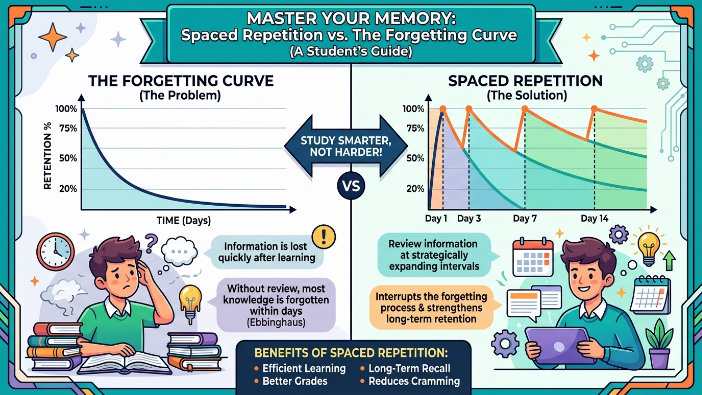
Apply Spaced Repetition for Long-Term Learning
🔁 Why Reviewing Matters
Without review, the brain forgets up to 70% of new information within 24 hours — a phenomenon known as the Ebbinghaus forgetting curve. Spaced repetition reverses it.
📆 Build a Revision Schedule
Review new material after 1 day, 3 days, 7 days, 14 days, and 30 days. This is the proven SM-2 algorithm used by leading flashcard platforms.
🛠️ Tools for Spaced Repetition
- Anki — gold standard for medical and language students
- Quizlet — beginner-friendly with multimedia cards
- Brainscape — confidence-based repetition
- RemNote — combines notes and flashcards
From Failing Pre-Med to NCLEX Pass on First Attempt
⚠️ Problem
Aisha, a nursing student in Toronto, failed two practice NCLEX tests and was spending 10+ hours a day on passive textbook reading.
⚙️ Process
She switched to Pomodoro blocks, built Anki flashcards for pharmacology, and took daily mock tests focused on weakest topics.
🏆 Outcome
Aisha passed the NCLEX-RN on her first attempt with study time reduced to 5 focused hours daily.
💡 Lesson Learned
Active recall and mock testing produce better outcomes than long passive study marathons.
Learn According to Your Study Style
Every learner processes information differently. Identifying your dominant style helps you choose techniques that maximize retention.
👁️ Visual Learning
Use diagrams, color-coded notes, infographics, and videos. Best for biology, anatomy, and geography.
✍️ Reading and Writing Methods
Write summaries, rewrite explanations in your own words, and use journals. Best for history, literature, and law students.
🧪 Practice-Based Learning
Kinesthetic learners absorb best through doing — labs, simulations, problem sets, and physical models. Ideal for math, chemistry, and engineering students.
| Learning Style | Best Method | Recommended Tool |
|---|---|---|
| Visual | Mind Maps, Videos | Miro, YouTube |
| Auditory | Lectures, Podcasts | Audible, Coursera |
| Reading/Writing | Summaries, Journals | Notion, OneNote |
| Kinesthetic | Labs, Practice Problems | Khan Academy |
Improve Memory and Concentration
🎯 Featured Snippet
How can students improve memory and concentration?
Students improve memory by getting 7–9 hours of quality sleep, drinking enough water, exercising regularly, eating brain-supportive foods, and using active learning techniques like recall and spaced repetition.
😴 Sleep and Memory Connection
The brain consolidates memories during deep sleep. Cutting sleep before exams reduces recall significantly.
💧 Stay Hydrated
Even mild dehydration reduces concentration by up to 12%. Keep water close during every study session.
🏃 Exercise and Brain Performance
30 minutes of daily cardio improves blood flow to the brain, boosts focus, and enhances memory consolidation.
Manage Exam Preparation Without Stress
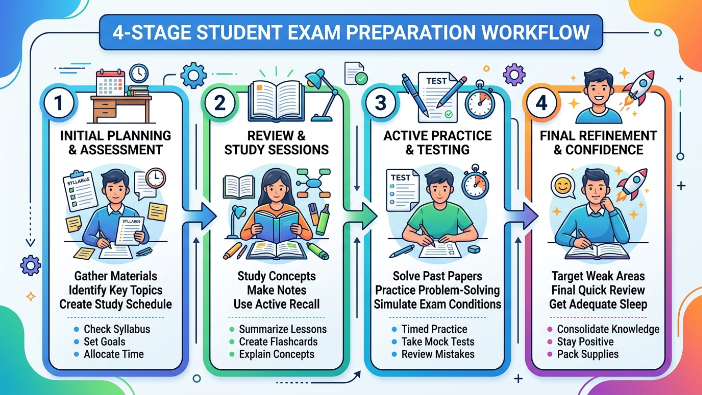
📅 Start Early
Begin focused preparation at least 4–6 weeks before the exam. Early starters score consistently higher than crammers.
🎯 Focus on Weak Subjects First
Devote 60% of study time to weak topics. This delivers the highest score improvement per hour invested.
📝 Use Mock Tests
Mock tests simulate exam pressure, expose gaps in knowledge, and improve time management. Take at least one full mock per week before exams.
⏰ Last-Minute Exam Week Checklist:
- Review summary sheets — not full textbooks
- Sleep 7+ hours the night before
- Eat a balanced breakfast
- Prepare exam materials the night before
- Arrive 20 minutes early
Best Productivity Habits for Students
🚫 Avoid Multitasking
Multitasking reduces effective learning by up to 40%. Focus on one subject at a time.
✅ Use a Daily Priority List
List your top three tasks every morning. Finish the most important one before checking messages.
⏳ Track Study Hours
Apps like Toggl, Forest, or a simple notebook reveal where your time actually goes — and where you can recover lost hours.
From IELTS Band 5.5 to 8.0 in 12 Weeks
⚠️ Problem
Rahul, an engineering graduate from Mumbai, needed IELTS 7.5+ for university admission in Canada but scored only 5.5 on his first attempt.
⚙️ Process
He built a 12-week schedule with daily Cornell notes, twice-weekly mock tests, and focused IELTS reading and speaking practice.
🏆 Outcome
Rahul scored Band 8.0 overall — exceeding the required threshold and securing his admission.
💡 Lesson Learned
A consistent 12-week plan with weekly mock testing outperforms unfocused 6-month study.
Common Study Mistakes Students Should Avoid
⏰ Last-Minute Cramming
Cramming creates short-term recall but fails for cumulative exams. Avoid it whenever possible.
📖 Passive Reading
Rereading textbooks feels productive but produces low retention. Always pair reading with self-testing.
🚫 Studying Without Breaks
Marathon sessions cause mental fatigue and decreased focus. Use Pomodoro or similar protocols.
🔄 Ignoring Revision
Without revision, even well-learned material fades. Schedule weekly reviews for all subjects.
Recommended Free Tools for Students
Modern students have access to powerful free platforms that automate planning, focus, flashcards, and notes.
📅 Study Planners
🍅 Focus Apps
🃏 Flashcard Tools
Explore curated AI tools for students and proven study prompts in our resource libraries.
❓ Frequently Asked Questions
Q1. What is the most effective study method?
Active recall combined with spaced repetition is the most evidence-backed study method. It produces higher long-term retention than rereading, highlighting, or summarizing alone.
Q2. How many hours should students study?
Quality matters more than quantity. Most students perform best with 3–5 focused hours per day using the Pomodoro technique, supplemented by weekend review sessions.
Q3. How can students improve focus?
Improve focus by silencing your phone, using a clean workspace, applying Pomodoro intervals, sleeping 7+ hours, and exercising daily. Small environmental changes have major effects.
Q4. What helps in exam preparation?
Start early, focus on weak subjects, take weekly mock tests, and use active recall with spaced repetition. Avoid cramming and prioritize sleep before exam day.
Q5. What are 5 good study habits?
(1) Set daily goals, (2) study in focused intervals, (3) use active recall, (4) revise with spaced repetition, and (5) get 7–9 hours of sleep nightly.
Q6. How do I stop procrastinating with studying?
Start with a 5-minute commitment. Once you begin, momentum carries you forward. Use the Pomodoro method, eliminate phone access, and reward small wins.
Q7. What is the best last-minute exam preparation strategy?
Focus on summary sheets and high-yield topics, attempt one mock test, sleep 7+ hours, and avoid learning entirely new material the night before the exam.
🎯 Final Recommendations
The top study tips for students all share one principle: study smarter, not longer. Build consistent habits — active recall, spaced repetition, Pomodoro focus blocks, Cornell notes, and weekly mock tests.
Small improvements compound into major exam results. Begin with one technique this week, master it, then layer on another. Within one semester, your grades and confidence will shift dramatically.
👉 Ready to apply these strategies?
📚 Resources
Written By
AIPROSTUDY Editorial Team
A collective of SEO strategists, learning scientists, educators, and digital-growth specialists dedicated to helping students unlock their academic potential. The team combines decades of expertise across academic publishing, cognitive science research, EdTech product development, and search engine optimization. Every guide is fact-checked, classroom-tested, and aligned with the latest research in learning psychology and study design.